If you've researched sustainable packaging options for your business, you've likely come across the terms recyclable, compostable, and biodegradable. They're often used interchangeably in marketing, but they don't mean the same thing — and choosing the wrong one can create confusion for your customers and even undermine your brand's sustainability goals.
For businesses, the right packaging decision isn't simply about selecting the "greenest-sounding" option. It's about understanding how your packaging will actually be disposed of in the markets where you sell, what infrastructure exists to support it, and how those choices align with your product and brand values.
In this guide, we'll break down what each term really means, where each option makes sense, and what businesses should consider before making eco-friendly packaging claims.
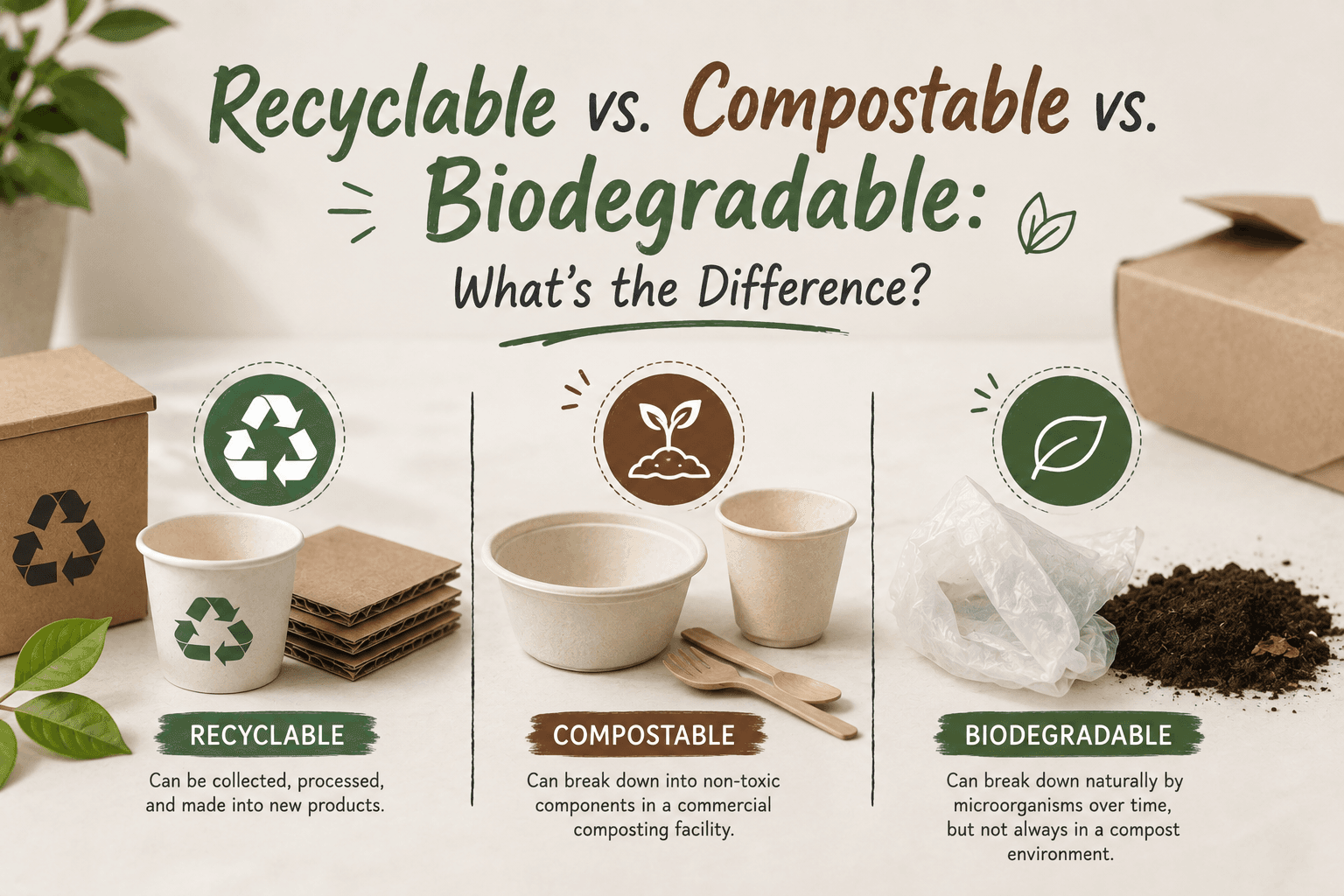
- Recyclable packaging can be processed and remanufactured into new materials, but relies heavily on local recycling infrastructure.
- Compostable packaging breaks down into organic matter, but usually requires specific commercial or home composting conditions.
- Biodegradable simply means it will break down naturally over time, but without certifications, it is considered a vague claim and is even heavily regulated in some regions.
At a Glance: Sustainable Packaging Comparison
| Feature | Recyclable Packaging | Compostable Packaging | Biodegradable Packaging |
|---|---|---|---|
| End of Life | Processed into new raw materials | Breaks down into nutrient-rich compost | Breaks down naturally over time |
| Special Conditions? | Requires municipal recycling collection | Yes (home or commercial composting environments) | Often yes, depending on the material |
| Standards | Varies widely by local jurisdiction | Strict certification standards exist (e.g., BPI) | Vague; often lacks clear timeframes |
| Best Suited For | Clean paper, cardboard, and paperboard | Food-soiled packaging and organic waste streams | Limited use as a standalone sustainability claim |
What Does Recyclable Mean?
A recyclable package is one that can be collected, sorted, processed, and manufactured into new products after use.
For custom paper packaging, this usually includes materials such as:
- Folding cartons
- Corrugated shipping boxes
- Kraft paper packaging
- Paper sleeves
- Paperboard inserts
However, being technically recyclable and actually being recycled are not always the same thing.
The biggest factor is local recycling infrastructure. A paper package that's accepted in one municipality may not be accepted in another. Collection systems, sorting technology, contamination rules, and local market demand all influence what gets recycled. A package may be perfectly recyclable in theory, but still end up in a landfill if the local recycling system doesn't process it.
Factors That Affect Recyclability
Brands should also understand that packaging design dictates whether a package can be successfully recycled. Common challenges include:
- Plastic laminations or heavy wax coatings
- Foil stamping or metallic layers
- Mixed-material constructions (e.g., paper with plastic windows)
- Heavy food grease contamination
- Difficult-to-remove labels or adhesives
The simpler the material structure, the easier it is for recycling systems to recover valuable paper fibre. Because paper recycling infrastructure is already well-established globally, designing for recyclability remains one of the most practical ways to reduce environmental impact.
What Does Compostable Mean?
Compostable packaging is designed to break down into natural, non-toxic organic matter without leaving harmful residues — but only under the right conditions.
Unlike biodegradable materials, compostable products must meet specific performance standards that define how completely and how quickly they decompose. Not all compostable packaging behaves the same way:
Home Compostable
Home compostable packaging can decompose in a typical backyard compost bin where temperatures are relatively low and conditions are less controlled. These products break down without industrial processing, although decomposition takes longer. This is highly convenient for consumers who maintain personal compost bins.
Commercially Compostable
Commercially (or industrially) compostable packaging requires specific facilities that carefully control:
- Temperature (high heat)
- Moisture
- Oxygen
- Microbial activity
These facilities allow materials to break down much faster than in a home pile. The challenge? Access to commercial composting varies significantly by city. If your customers don't have access to a municipal green-bin program, commercially compostable packaging usually ends up in the landfill, where it may not break down properly.
What Does Biodegradable Mean?
Biodegradable simply means a material can eventually be broken down by naturally occurring microorganisms.
However, what the term doesn't tell you is:
- How long the process takes
- What conditions are required (e.g., sunlight, oxygen)
- Whether micro-plastics or harmful residues remain
A material may technically be biodegradable yet require decades to fully decompose in a landfill. Because it is so vague, "biodegradable" on its own is largely considered a weak sustainability claim. In fact, due to widespread greenwashing, regions like California have strict laws prohibiting the sale of plastics labeled simply as "biodegradable" unless they meet strict scientific standards.
Without additional context or certification, this label provides little practical information for consumers or procurement teams.
Which Option Is Best for Your Packaging?
There isn't a universal answer. The best end-of-life solution depends on your product, your customer's behaviour, and your market's infrastructure.
Recyclable paper packaging often makes sense when:
- Your packaging remains clean and dry after use.
- You sell into markets with mature paper recycling systems.
- Your goal is to support a circular economy for paper fibres.
Compostable packaging may be a better fit when:
- The packaging is likely to become heavily contaminated with food (e.g., takeout containers).
- Food contamination would render standard recycling impossible.
- Your customers have easy access to organic waste collection.
Biodegradable packaging may be appropriate when:
- The material has credible third-party certifications explaining its exact performance.
- The intended disposal environment is clearly understood and guaranteed.
Questions Brands Should Ask Before Ordering Packaging
Instead of asking, "Which material is the most sustainable?", decision-makers get better results by asking our packaging experts:
- Where will most of our customers dispose of this packaging?
- Is recycling or composting infrastructure actually available there?
- Will food contamination prevent this from being recycled?
- Can we simplify our packaging structure (removing laminates or plastics) without sacrificing performance?
- Are we making environmental claims we can actually substantiate?
These questions often have a much greater impact than simply chasing a specific sustainability label.
Don't Forget About Certifications
Environmental claims should always be backed by credible third-party certifications. Depending on your material and market, look for certifications related to:
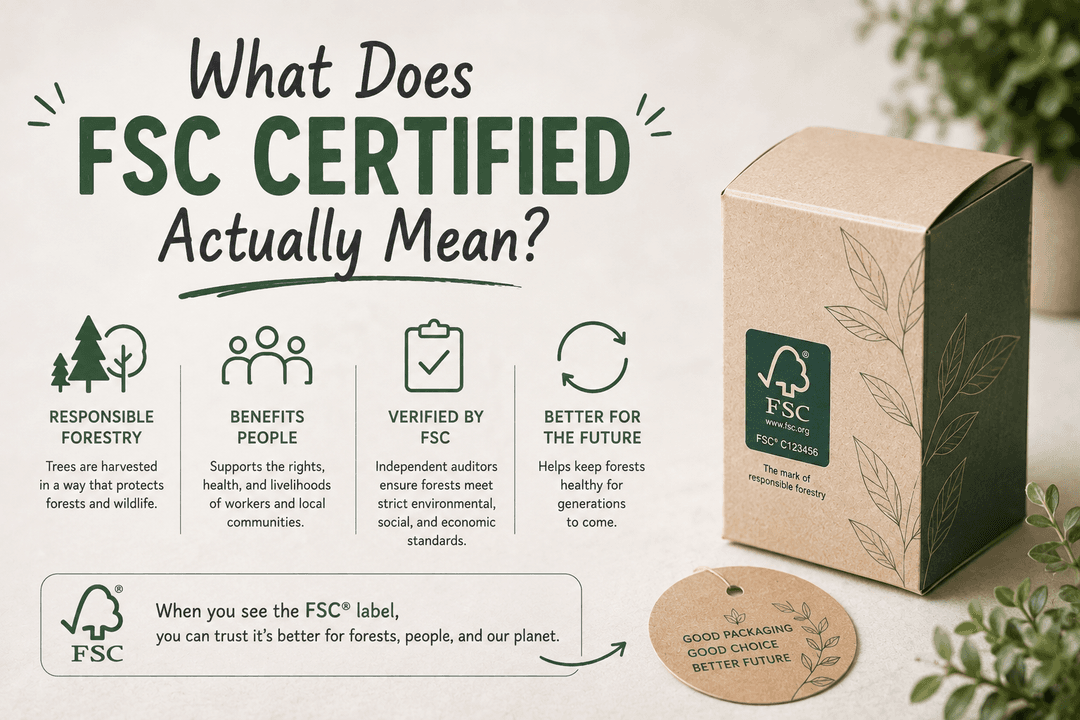
- Responsibly Sourced Fibre: Such as FSC® (Forest Stewardship Council) certification.
- Compostability: Such as BPI (Biodegradable Products Institute) certification.
- Recyclability: Widely Recycled or How2Recycle labels.
Certifications provide your customers with confidence that your environmental claims have been independently verified.
The Bottom Line
Recyclable, compostable, and biodegradable packaging all play an important role, but they solve entirely different problems.
For most custom packaging applications, recyclable paper materials remain the most practical and effective choice because the recycling infrastructure is already widely available to consumers.
Ultimately, the most sustainable packaging isn't defined by a single buzzword. It's the packaging that protects your product, aligns with available waste systems, and can realistically achieve the environmental outcome it was designed for.
Need Help Designing Sustainable Packaging for Your Brand?
Choosing the right material shouldn't be a guessing game. At Printline, we specialize in manufacturing high-quality, eco-friendly printing and packaging solutions tailored to your product's specific needs.
Contact our packaging experts today to discuss how we can help you build packaging that looks incredible, performs flawlessly, and meets your sustainability goals.